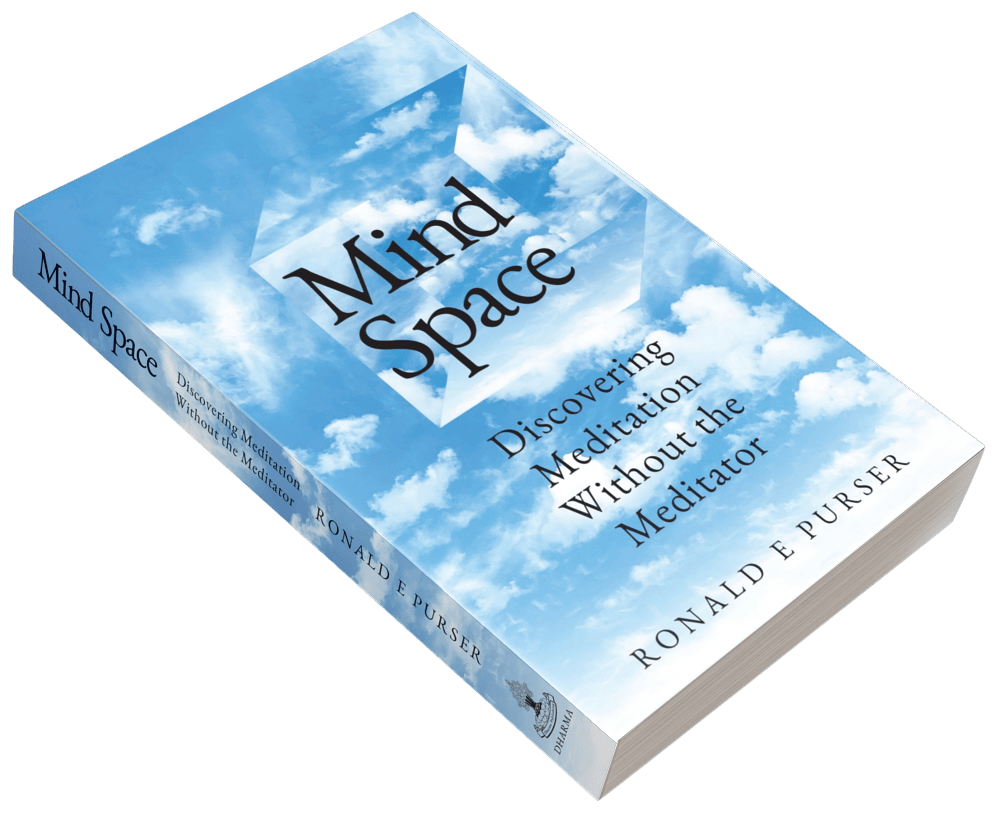
Mind Space
We are told to sit still, focus on the breath, and watch our thoughts. But what if the very act of "being mindful" is what keeps us trapped?
In Mind Space, Ronald E. Purser, the international bestselling author of McMindfulness, turns meditation inside-out. The peace and clarity we seek through meditation, hopefully attained after a long and disciplined struggle on a path, is often fraught with doubts, obstacles and frustration. Lurking in the background is a compulsive inner manager, constantly monitoring our spiritual progress. Are we being mindful enough? Have we tamed our thoughts and ruminations? Are we paying attention to the present moment? Purser shows how this goal-orientation creates a trap that defers our fulfillment, blocking access to an unconditioned inner freedom.
Drawing from the renowned Tibetan Buddhist master Tarthang Tulku’s visionary “Time, Space and Knowledge” seminal teachings, Purser provides a radical alternative to formal meditation that goes beyond stress reduction or attention training, dispensing with the endless pursuit of results: a way of practicing meditation without the meditator.
By learning how to recognize and embody the openness of Space, a new vision of reality naturally unfolds. Through a combination of reflective prose, experimental exercises and imaginary dialogues, Purser gently introduces and invites us into this new vision, allowing for an organic growth of understanding that naturally unties the knot of self-centeredness. By letting go of the subtle inner manager, a natural concentration and unfabricated presence arises that is not limited to formal meditation sessions.
As a deep sense of appreciation and wonder emerges, the taste of an expansive freedom and heart-centered intimacy becomes available in every moment – our true refuge of Being. Life itself then becomes a constant field of practice where the most ordinary shimmers in sacredness-the blue-sky overhead, a difficult meeting at work, a glimpse of light falling across the floor-all reveal a hidden brilliance and the open dimension of Mind Space.
BUY THE BOOK






ABOUT THE AUTHOR
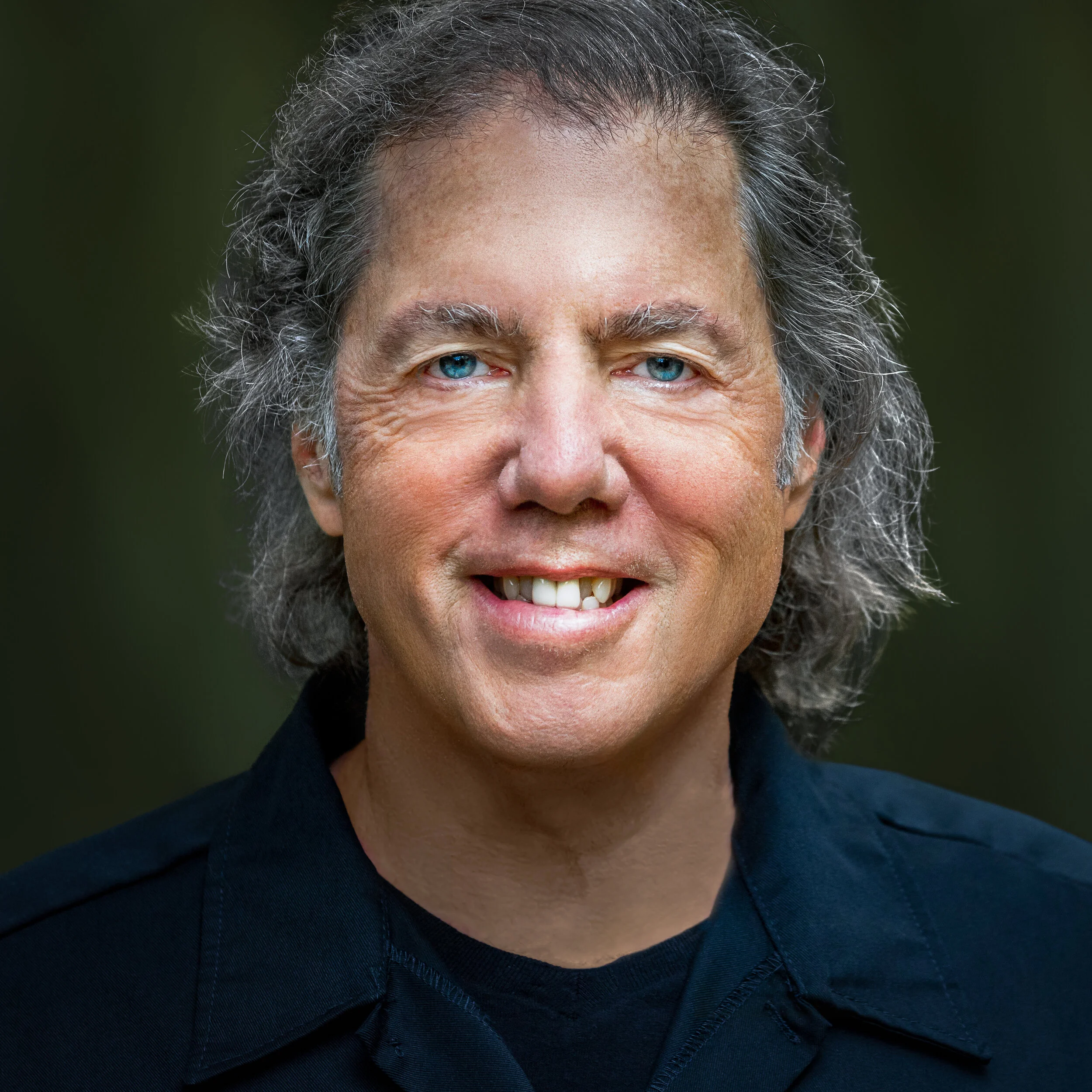
Ronald Purser is the Lam Larsen Distinguished Research Professor of Management at San Francisco State University and the internationally recognized author of McMindfulness: How Mindfulness Became the New Capitalist Spirituality, a book that sparked a global debate on the commodification of mindfulness meditation. His work has been featured in over a hundred major media outlets, including such TV shows On Contact with Chris Hedges, Redacted Tonight with Lee Camp, as well as radio interviews on the BBC, Canadian Broadcasting Corporation, Radio New Zealand and local public stations. His essays and opinions have appeared international news media, including The New York Times, The Guardian, Financial Times, The Nation, Salon, The Huffington Post, The Irish Times, Metro, The Standard, The San Francisco Chronicle, The Sydney Morning Herald, as well as many magazines such as Fast Company, Vice, The New Statesman, The Saturday Evening Post, Truthout.org, The Telegraph, Los Angeles Review of Books, Current Affairs, and Tricycle. Purser is also a frequent guest on popular podcasts such as The ZDoggMD Show, The Chauncey DeVega Show, The Wright Show, and Upstream.
A long-time student of the Tibetan lama Tarthang Tulku’s visionary book “Time, Space, and Knowledge” (TSK), Purser has been studying and practicing the teachings from this seminal book for over forty years. Today he is an instructor at Dharma College in Berkeley, California, where he leads courses and seminars on Mind Space and TSK for contemporary audiences. He lives in Pacifica, California.
ABOUT THIS JOURNEY
When I first encountered Tarthang Tulku’s Time, Space, and Knowledge (TSK) in 1979, as a college freshman, I sensed that there was something about it that felt immediate and important; yet, when I opened the book and started reading, I found myself to be way beyond my comprehension. I didn’t understand much of anything, but I still felt a strong intuition that I was somehow connected to this work.
A few years later, after moving to the San Francisco Bay area to attend college, I discovered (by chance) that the Nyingma Institute in Berkeley was going to offer an introductory TSK course. I enrolled in the class based on pure whimsy. This whim quickly evolved into taking the one-year intensive TSK program, which involved a small group of approximately 5 students, long evenings of discussion, weekend retreats. Little did I know at the time this experience quietly altered the trajectory of my entire life.
After decades, during the COVID-19 pandemic, I began teaching TSK courses at Dharma College. For some reason, during this odd period of history, people from all over the world began to show up -- both veteran practitioners and those who were brand-new to meditation -- all looking for something deeper than just ways to relieve their stress. In many ways, it felt like the TSK vision was coming back alive. This excitement led to a global gathering of TSK students in 2022, where Tarthang Tulku (who is affectionately known as Rinpoche) sent us an inspiring essay urging us to create new coursework and commentaries to support the growth of the vision to a wider audience. The encouragement he provided to support this effort was the push I needed to start writing.
This project commenced when I was on retreat at Odiyan, Tarthang Tulku’s country center located in Northern Sonoma County. I initially drafted the first version of the book as a traditional commentary in a more scholarly and rigorous style, an exegesis that closely followed the original text. When the editorial staff at Dharma Publishing encouraged me to re-write it for a broader audience, I finally realized that they were correct: the TSK vision needed to be expressed in a style that was expansive, imaginative and accessible. As soon as I gave up the notion that I was finished writing, I was able to allow the writing to unfold. Mind Space is the result of that process, an attempt to render a visionary and transformational teaching into a book that could be picked up by anyone and instantly feel its vitality.
Other Books by Dr. Ron Purser